
India’s pharma commercial leadership and the people building AI for it, in the same room.
Pharma commercial leadership down one side, the people building AI down the other, and the agenda on the table between them. Everything you need to know about AI in commercial pharma, in one room. One seat is held for you.
Pharma and AI are in different rooms. We are putting them in the same one.
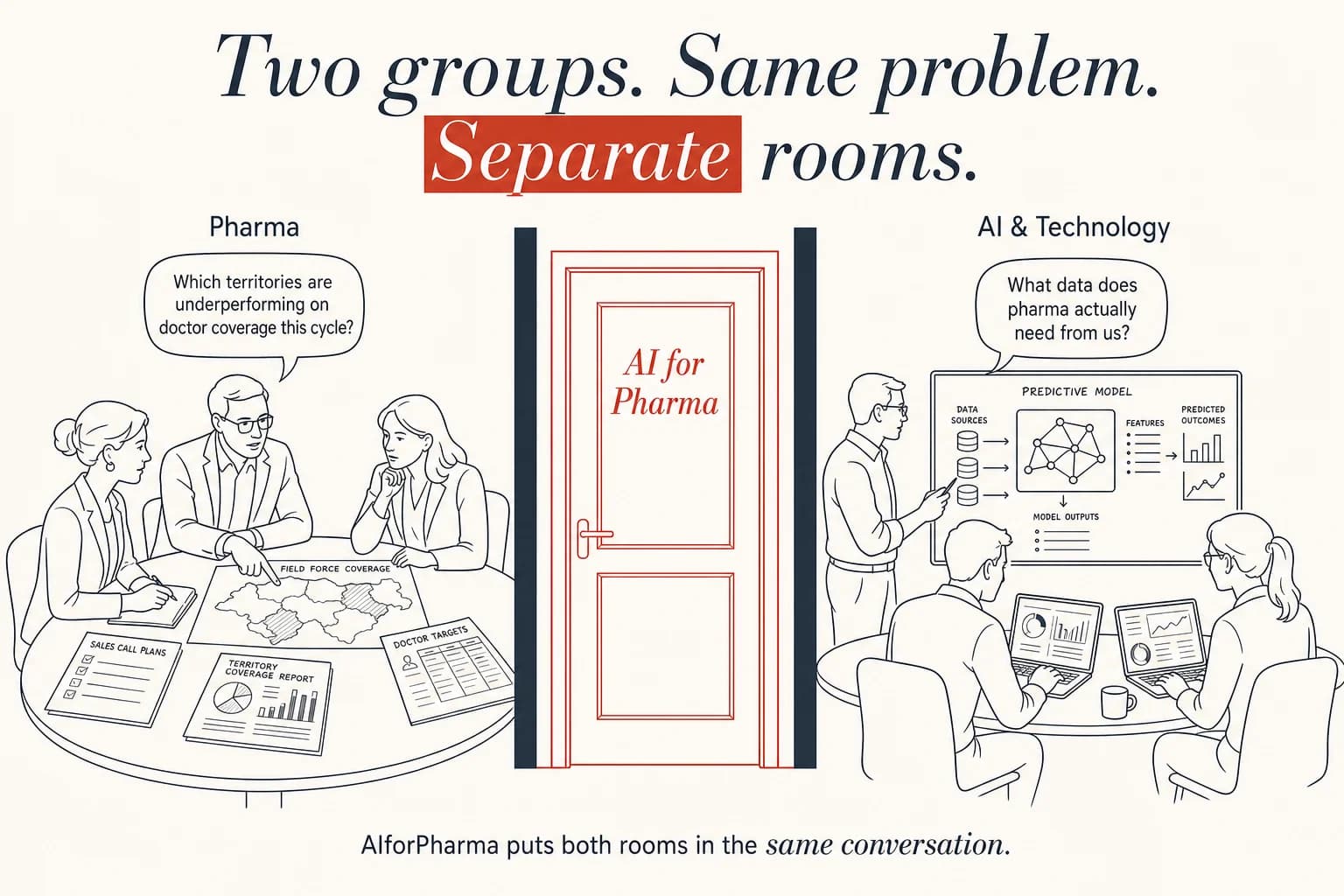
India is the third-largest pharmaceutical producer in the world. It supplies roughly twenty percent of the global generics market. The country has more than three thousand pharma companies, and roughly half of them are still at proof-of-concept stage with AI. The gap between where the industry is and where it needs to be is large, and closing.
That gap exists because two groups of professionals operate in separate rooms. Pharma people do not fully understand what AI can do for their specific function. AI and technology people do not fully understand what pharma professionals actually need. The result, everywhere else, is slow adoption, bad implementations, and a great deal of wasted potential on both sides.
AI for Pharma is the structured space we are convening so that conversation happens. Three to four editions a year. Senior, curated, recurring. The relationships compound; the conversation carries forward.
- 01Chief Commercial Officers
- 02VPs of Sales and Marketing
- 03National and Regional Sales Managers
- 04Brand Managers
- 05Heads of Sales Excellence and Commercial Ops
- 06Heads of Commercial Analytics
- 07Chief Information and Digital Officers
- 08GMs of Data and Infrastructure
- 01Foundation-model companies
- 02Enterprise cloud platforms
- 03Data and observability vendors
- 04Pharma-focused AI startups
- 05AI engineering and product leaders
We invite by role and contribution, not by logo. The room is who’s in it; specific organisations get named in edition recaps, with permission.
Four things, on a deliberate cadence.
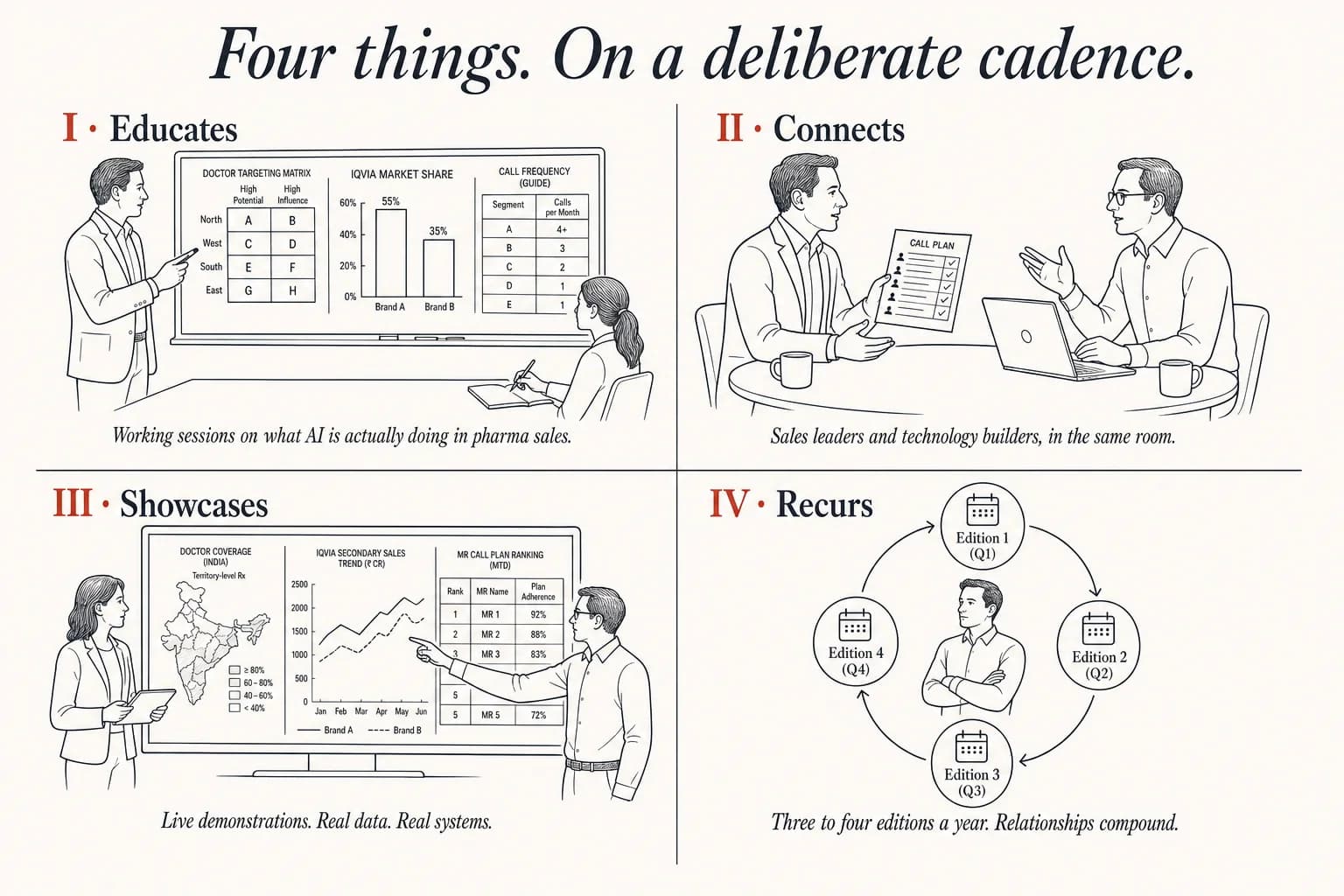
- I
Educates
Working sessions on what AI is actually doing in pharma's commercial operations.
Sessions on sales-force effectiveness, brand and marketing analytics, commercial data foundations, and forecasting. Not theory: real workflows, named tools, real outcomes. A National Sales Manager and the engineer who built her call-plan model sit on the same panel.
- II
Connects
Commercial leaders and the technology companies building for them, in the same conversation.
Editions are senior, curated, and small enough that the room can recognise itself. A National Sales Manager and the engineer who built her call-plan model sit on the same panel; a Brand Manager and the data-science lead at her cloud vendor sit on the next one. No vendor booths. No badge-scanning. Conversations begin in sessions and continue in side rooms, dinners, and follow-up calls.
- III
Showcases
Live demonstrations of AI applied to actual pharma problems.
Including PharmaOS, but not limited to it. Demos are real systems against real datasets, not slideware. Failures are discussed as candidly as successes.
- IV
Recurs
Three to four editions a year, so the conversation carries forward.
A consortium, not a conference. Between editions, the conversation lives in a private group of attendees. Each edition picks up from the last; the relationships compound rather than reset.
The largest pharma industry in the world, mid-way through its AI question.
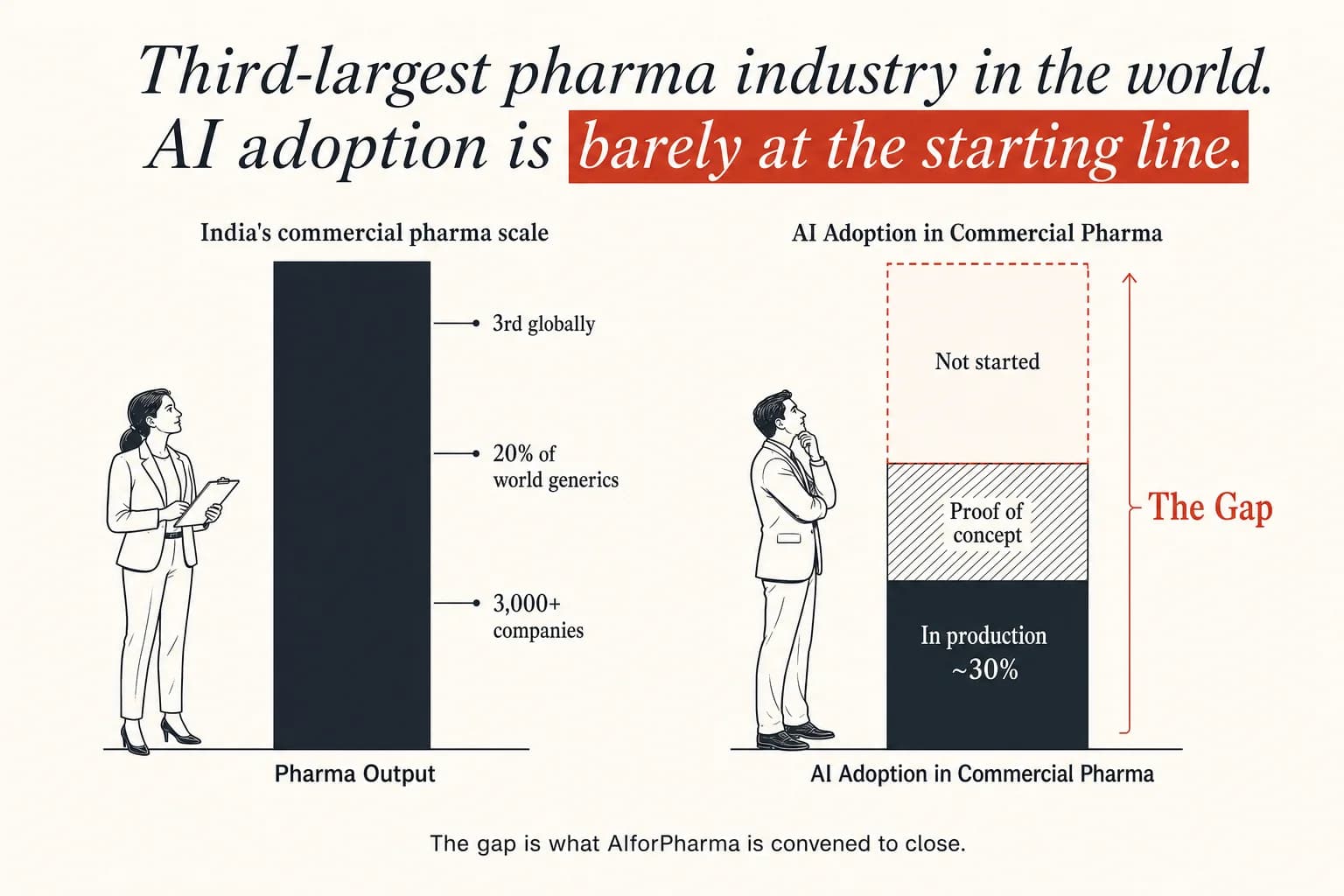
- 3rdlargest pharmaceutical producer in the worldby volume; public industry data
- 3,000+pharma companies operating in Indiaacross formulations, APIs, and CDMOs
- 20%of the global generics market supplied from hereby volume; widely cited industry estimate
- ~50%of Indian pharma is reported to be at proof-of-concept stage with AIindustry observation, 2024–2025
The gap between where the industry is and where it needs to be is large, and the cost of closing it badly is high. AI for Pharma exists so the closing happens with intention, in a room where both sides can recognise each other.
Edition 01 is being convened. Apply to be in the room.
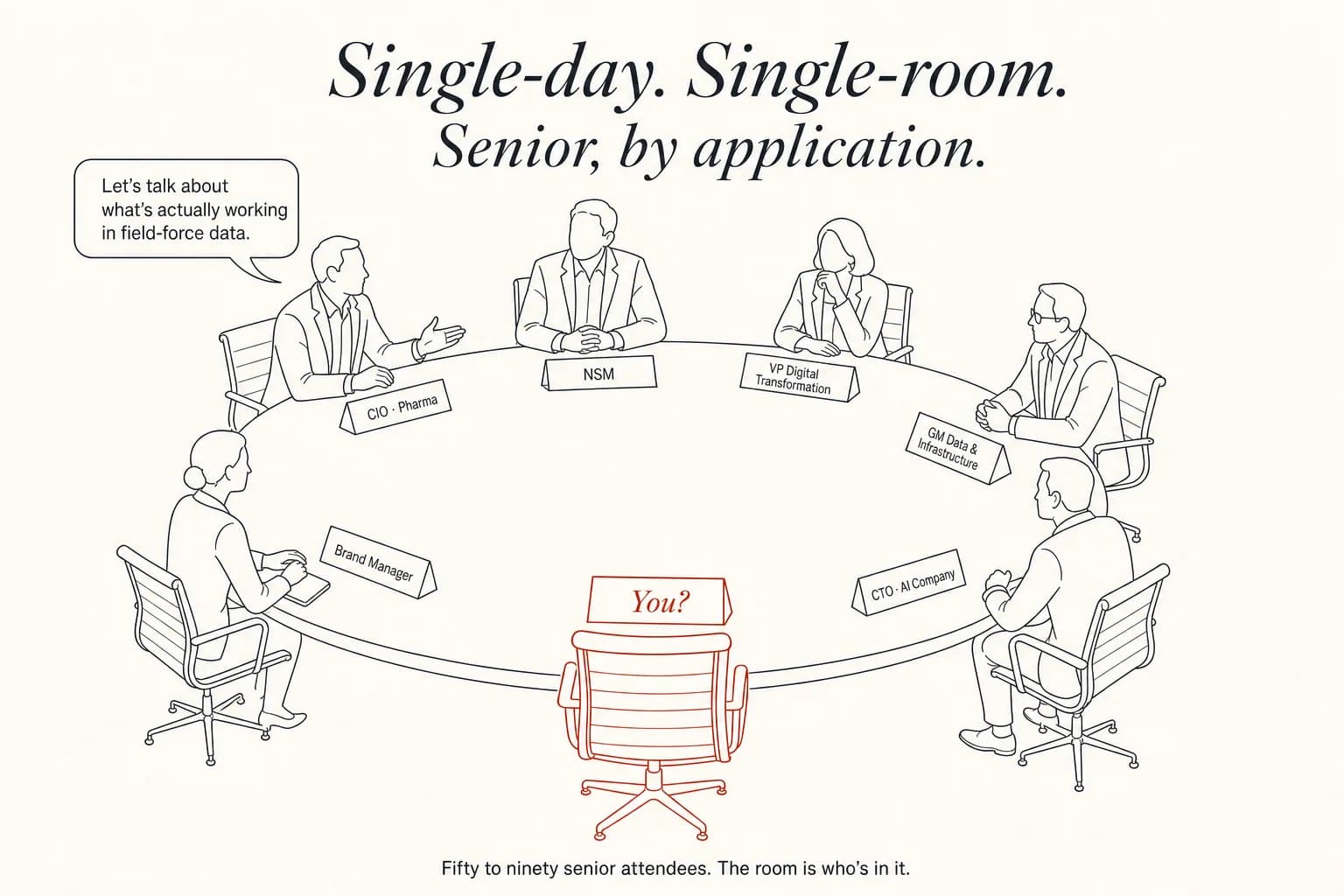
The first edition will be single-day, single-room, and small enough that the room can recognise itself. Date and venue are being finalised and will be announced to invited applicants first. The application takes about seven minutes; the team reads every application in full.
- Single-day, single-room
- Senior attendees only
- Four working sessions, two demonstrations
- Curated dinner the evening prior
- Closed Chatham House rule
- Sales-force effectiveness: smarter call plans, territory by territory
- Brand and marketing: what actually moves your IQVIA market share
- Commercial data: getting primary, secondary, IQVIA, and SMSRC onto one shared territory map
- Forecasting: demand planning that survives the next month's data
- Director-level or above at an operating pharma company in India
- Senior leadership at a technology company building for pharma
- Applications reviewed on a rolling basis
- All applicants receive a reply, one way or the other
Convened by the team behind PharmaOS, who were already in these conversations.
AI for Pharma is organised by the team behind PharmaOS, a Super AI product that lets pharma companies query their own commercial data in plain language. The consortium grew directly out of conversations the PharmaOS team was already having with commercial leaders, Brand Managers, sales-excellence heads, and CIOs across the industry.
The conviction underneath the consortium is simple: the most useful version of this conversation does not happen in a vendor pitch, and it does not happen on a webinar. It happens between peers, in a room small enough to hold a real disagreement, on a schedule recurrent enough that the disagreement gets resolved by the next edition.
AI for Pharma is not a product showcase. It is those conversations made public, with more of the right people in the room.
The edition is the highlight. The conversation is the product.
Between editions, the consortium will live in a private group of attendees. The intent is straightforward: a question on why your SMSRC and IQVIA numbers disagree gets answered by the person who solved it at a peer company. A new IQVIA data cut lands and the group reads what moved together in real time. The next edition’s agenda is shaped by what the group has been arguing about for three months.
Membership in that private group is extended to attendees after their first edition. It is moderated, off the record, and small enough to recognise itself. It begins with the founding edition.
In the meantime, there is an open WhatsApp community for everyone following the work: AI inside Indian pharma’s commercial and field-force operations. Join it for updates and the conversation as it happens.
- Cadence
- editions a year, alternating cities
- Room size
- selected attendees per edition
- Format
- single room, Chatham House
- Entry
- reviewed by the organising team
Applications for the founding edition are open. Reviewed weekly.
Tell us where you sit, and why this room would be useful.
Applications take roughly seven minutes. They are reviewed by the organising team within seven days. Accepted applicants receive a formal invitation, along with the date and venue for the founding edition.
Begin the application- 01Your name, role, and organisation
- 02Which function you lead, and what AI question is on your desk right now
- 03Two sentences on what you would bring to the room
- 04Whether you would like to be part of the founding edition or wait for a later one
Not at director level yet, or working in an adjacent commercial function (sales operations, trade marketing, market access)? Write to room@aiforpharma.ai and we will route the request.